




Hair Transplant: What You Need to Know Before Treatment
11/02/26
Understanding Your Hair Restoration Options
Hair loss can develop gradually, making it difficult to know when treatment is appropriate or which option may be suitable. A proper consultation should look beyond the amount of hair that has been lost and consider the pattern of loss, available donor hair, medical history and individual expectations.
At Hair Transplants of The Royal Liver Building, each patient is assessed individually before treatment is recommended. Surgical procedures are carried out at Cosmetic Surgery of The Royal Liver Building, a CQC-registered clinic in Liverpool. For suitable patients, FUE can provide a way of redistributing existing hair follicles from a donor area to areas affected by thinning or hair loss.How FUE and DHI Work Together
Follicular Unit Excision, commonly known as FUE, involves removing individual follicular units from the donor area before placing them into areas where additional density is required.
DHI, or Direct Hair Implantation, refers to an implantation technique that may be used during FUE. It is not a separate follicle extraction method. The appropriate implantation approach depends on the patient’s treatment plan, the characteristics of the donor hair and the area being treated.
The aim is to create a natural-looking distribution that works with the patient’s existing hair rather than simply placing as many follicles as possible.
You can read more about FUE Hair Transplant Liverpool and FUE Hair Restoration Liverpool.
Why Your Consultation Matter
A consultation is an important part of the process because not everyone experiencing hair loss is automatically suitable for surgery.
Your hairline, crown, donor area and pattern of loss can all influence the recommended approach. Your medical history and expectations also need to be considered.
Surgery redistributes existing donor follicles rather than creating new ones, so careful planning is important when considering both current hair loss and potential future progression.
Find out more about Hair Transplant Treatment and what the procedure involves.
What Happens During Treatment?
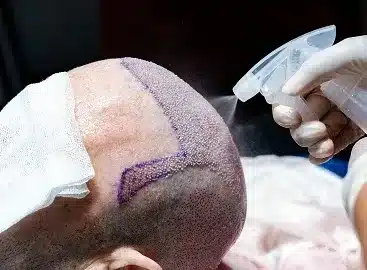
Hair transplant surgery is carried out under local anaesthetic. Treatment times vary depending on the number of follicles being transplanted and the size of the area being treated.
Smaller procedures may take around three to four hours, while more extensive procedures can take approximately six to seven hours.
Individual follicles are removed from the donor area before being prepared and implanted into the recipient area. Their positioning is considered carefully, including direction, angle and distribution.
The objective is not simply to fill an area but to create a result that works naturally with the surrounding hair.
Recovery and Aftercare
After treatment, patients receive detailed aftercare guidance. Keeping the head elevated, avoiding unnecessary touching or rubbing and following the recommended saline routine can help support the early healing period.
Hair should generally not be washed for the first 48 hours unless otherwise advised. After this, gentle washing can be introduced according to the clinical team’s instructions.
Strenuous exercise and heavy lifting should generally be avoided for around two weeks. Swimming, saunas and steam rooms should be avoided for approximately four weeks.
Patients should also take care with direct sunlight, excessive sweating, dust and tight hats or helmets during the early recovery period.
Comprehensive aftercare forms an important part of the overall treatment process.
When Will You See Results?
Hair growth following surgery takes time. It is not unusual for the transplanted area to look different during the early stages of healing, and temporary shock loss can occur.
Visible improvement may begin from around six months, although the final development of the transplanted hair can take approximately 12 to 18 months.
Results vary between individuals and can be influenced by the quality of the donor area, the pattern of hair loss, the number of follicles transplanted and how the hair develops after surgery.
You can view examples in our Hair Loss Clinic Results section and read more about Hair Transplant Results and Patient Satisfaction.
Hair Restoration Beyond the Scalp
Hair restoration is not limited to the scalp. For suitable patients, transplantation can also be considered for areas such as the beard and eyebrows.
Our Beard Transplant Liverpool information explains more about treatment for patients looking to improve beard density or definition.
For patients with sparse or missing eyebrow hair, an Eyebrow Transplant Liverpool procedure may also be considered following consultation.
Planning for Long-Term Hair Loss
One of the most important considerations is that existing hair loss can continue after surgery. A treatment plan should therefore consider both the area currently affected and the potential future pattern of loss.
Depending on the individual circumstances, more than one procedure may sometimes be appropriate. A consultation provides an opportunity to discuss what is realistic before making a decision about treatment.
Frequently Asked Questions – Hair Transplant
No. Suitability depends on factors including the cause and pattern of hair loss, available donor hair, medical history and expectations.
The procedure is performed under local anaesthetic. Your clinical team will explain what to expect during your consultation.
The initial healing period is relatively short, but transplanted hair takes considerably longer to develop. Final results can take 12 to 18 months.
Temporary shedding can occur after treatment. Hair growth develops gradually over the months following surgery.
Some patients may require or choose to have further treatment. This depends on factors including the available donor area, ongoing hair loss and the overall treatment plan.
Patients considering overseas surgery should think carefully about consultation, aftercare and continuity of care once they return home. Our guide to Hair Transplants Turkey explains some of the factors worth considering.
Book Your Private Consultation
If you are considering hair restoration, the first step is an individual consultation. Your hair loss, donor area, medical history and expectations can be assessed before treatment is recommended.
Hair Transplants of The Royal Liver Building provides specialist hair restoration in Liverpool, with surgical procedures carried out at Cosmetic Surgery of The Royal Liver Building.
Meet Dr Waqas Nazir – Medical Lead
Dr Waqas Nazir is Medical Lead at Cosmetic Surgery of The Royal Liver Building and has a senior clinical role across the practice, including its hair restoration programme. His role includes maintaining clinical standards, patient care and the wider direction of the service.
Further Reading
Hair Transplant Treatment
Hair Loss Clinic Results
FUE Hair Transplant Liverpool
Hair Transplant Results and Patient Satisfaction
Hair Transplant Surgery in Liverpool
DHI Hair Transplant
Male Hair Loss Treatment Liverpool
FUE Hair Restoration Liverpool
Hair Transplants Turkey
Beard Transplant Liverpool
Eyebrow Transplant Liverpool
[wpforms id="31869" title="false"]
Book your
consultation today!
And Start Your Hair Journey Today!
[wpforms id="31869" title="false"]